Be yourself; Everyone else is already taken.
— Oscar Wilde.
This is the first post on my new blog. I’m just getting this new blog going, so stay tuned for more. Subscribe below to get notified when I post new updates.
Be yourself; Everyone else is already taken.
— Oscar Wilde.
This is the first post on my new blog. I’m just getting this new blog going, so stay tuned for more. Subscribe below to get notified when I post new updates.
Reference list
Ribble, M. 2017. Nine elements, digital citizenship. Available at: https://www.digitalcitizenship.net/nine-elements.html. Online: [Accessed 30 September 2019]
Heginbotham,G. 2017. Could Digital Footprints Become A Problem. Available at: https://16034653.wixsite.com/digitalmarketing/single-post/2017/05/15/Could-Digital-Footprints-Become-A-Problem. Online: [Accessed 30 September 2019]
The independent institution of education 2019 Digital C module manual: unpublished.
Natverlal, P. 2018. How can a digital citizen can build and enhance social capital? Available at: https://pratishwhatisdigitalcitizenship.wordpress.com/2018/03/26/how-can-a-digital-citizen-can-build-and-enhance-social-capital/. Online: [Accessed 28 September 2019]
According to Natverial,P 2018. Social capital is the networks built amongst people who live and work in a particular society which allows the society to work accordingly and function effectively.
As a Digital citizen, it is essential to utilize interpersonal organizations to share and process data in a work environment, one of the significant variables of being an advanced citizen are that it could transform you and make you a superior individual socially. A digital Citizen knows how to make to make use of these platforms in a manner that would benefit them corporately. These stages can help assemble social capital and make an incentive among the social individuals that are associated.
This stages can help increment social capital by communication, they could be a bit of advantage to an individual that realizes how to sell an item and impart adequately. Being regarded through your communication with others online can manufacture social capital which makes it simpler to sell an item in light of the fact that the association has been made. These stages can help make a bond with the client, trust, and well being, and could give them native power among the online residents.
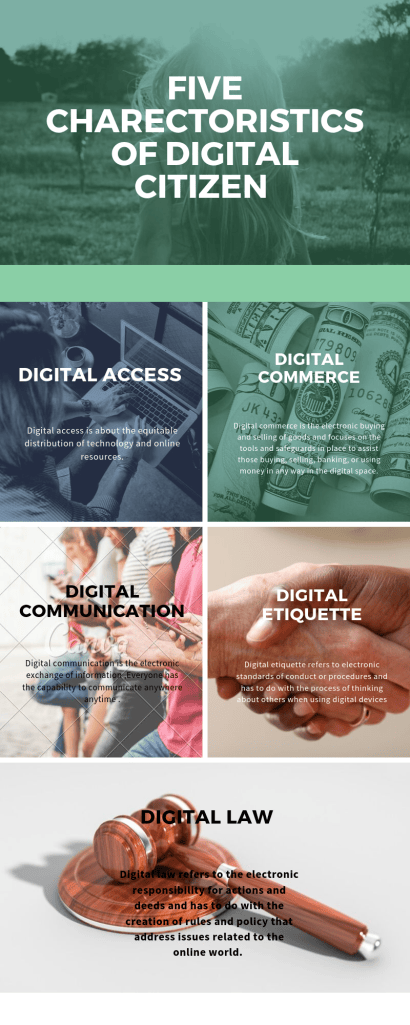
Digital access is the ability to fully participate in digital society. This includes access to tools and technologies, such as the Internet and computers, that allow for full participation. It is about the impartial appropriation of innovation and online assets. Educators and executives should know about their locale and who might approach, in school as well as at home too. Teachers need to give alternatives to exercises and information accumulation, for example, free access in the network or give assets to the home. (Nine elements 2014)
Digital Commerce The buying and selling of goods and services using the internet, mobile networks and commerce infrastructure. It includes research and marketing activities that support these transactions, including the people, processes and technologies used to execute all touchpoints through the customer’s buying journey. (Nine elements 2014)
Digital Communication is the electronic exchange of information, electronic transmission of information that has been encoded digitally. All users need to define how they will share their thoughts so that others understand the message. (Nine elements 2014)
Digital Etiquette refers to electronic standards of conduct or procedures and has to do with the process of thinking about others when using digital devices. Digital etiquette is integrity, or sense of self management, and general responsibility for your actions as well as yourself on the internet and treating people like you would in real life. Some basic digital etiquette would be like respecting others, following the rules of the website you’re using, or just being kind to others. (Nine elements 2014)
Digital fluency is the aptitude to effectively and ethically interpret information, discover meaning, design content, construct knowledge, and communicate ideas in a digitally connected world. It is the process of understanding technology and its use. The better educated or “digitally fluent,” people are, the more likely they are to make good decisions online, like supporting others instead of making negative comments. Digital literacy includes the discussion of media literacy and the ability to discern good information from poor, such as “fake news” from real news. (Nine elements 2014)
Digital Health refers to the physical and psychological well-being in a digital world. This is about using technology to help improve individuals’ health and wellness. Technology provides many opportunities and enjoyment, but knowing how to segment use with the needs of ourselves and others is key to a healthy, balanced life. (Nine elements 2014)
According to IIE (2019), Digital security refers to ensuring the ability to use digital information system without interference disruption, unauthorised access or data collection.
Digital security is the protection of this online identity that also include the tools you can use to secure your identity, assets and technology in the online and mobile world. (Nine elements 2014)
According to the IIE (2019) Digital rights and responsibility are the privileges and freedom extended to all digital technology users and the behavioural expectations that come with them.
This area of Digital Citizenship is about helping people understand that when they are provided opportunities, such as the access to the Internet and use of online products, they need to be diligent in helping others as well.
Digital footprint will become a problem when we have something on the internet we don’t want there, such as a drunken/inappropriate photo. This could negatively affect our chances of getting into a university or a job.
Although, digital footprint is useful for connecting with old friends, to have a good online reputation and help users contact content creators, therefore it is next to impossible to remove yourself from the digital world as many of us use devices every day that a transmitting data. (Heginbotham,G 2017)
ANNETTE MOLALA
DIGITAL CITIZENSHIP
MEDIA FLUENCY
Link: https://youtu.be/r_M0w4DLFQQ
LISTENING
MESSAGE
There are no particular things happening in the video it is dull and the is no background movement or any lights flashing in the video which makes us focus on the messages from the interview.
VERBALIZE
The message from the video is direct and there are no words covering up or that need interpretation.
VERIFY
The interview is based on the interviewee’s opinions, the questions were about her personal views in the sports she plays and her experiences in the season.
LISTENING
MEDIUM
The medium used is appropriate for this type of video, the delivery of the message was unusual because the setting was different and the answers of the interviewee are not particular it is just her thoughts.
FORM
There was no particular movement happening. There were no lights or any background sounds which makes the video interesting, you are able to focus on what the people are talking about.
FLOW
The message in the video is made clear and is easy to understand. The information from start to finish is flowing easy.
ALIGNMENT
The audience is the people who play and watch sports, people who are interested in Maria Folau. The interview is straight forward and interesting
According to Kula (2017) a digital divide is a division of the population in such a way that some are able to fully take advantage of opportunities in a digital economy, while others can’t.
A digital divide is any uneven distribution in the access to, use of, or impact of information and communication technologies between any numbers of distinct groups. These groups may be defined based on social, geographical, or geopolitical criteria, or otherwise.
In the townships there are more people who need free resources which prevents them from receiving free fibres and internet cafes. The schools in Soweto are also more disadvantaged than because of the number of students they have, therefore they get limited access to digitals.
This issue can be solved by providing free Wi-Fi in schools and communities in the township so that the people from the suburbs receive the same technology. Laptops can provided by governments in public schools and libraries for the community to use for free.
Bibliography
Kula, S. 2017, The Digital Divide is Real. Michalsons, 31 May 2017. [Online] Available at: https://www.michalsons.com/blog/the-digital-divide/28927 [Accessed 06 August 2019]
19014113 Annette Molala
Have a WordPress.com account? Log in now.

